[Note: This week’s post is a guest post from Matt Podolsky, the host the Common Land podcast. This season’s show is an exploration of his hike of the AT in 2022 and what he learned along the way.]
I completed a thru-hike of the Appalachian Trail in 2022. Because I had ambitions to produce a documentary-style podcast series about my journey and the trail itself, my trip had a research element to it. I read all about the AT’s history before I began my hike, and I continued reading once I was on the trail. I also listened to podcasts while I walked, and early on in my hike I was introduced to The Green Tunnel, hosted by Mills Kelly.
What I loved about The Green Tunnel was how Mills and his students uncovered parts of the AT’s history that felt obscured. They produced episodes that show how Indigenous history and the history of racial segregation intersect with the AT, and they examined how people were uprooted to make way for Shenandoah National Park. I listened to every episode that I could get my hands on while walking on the AT.
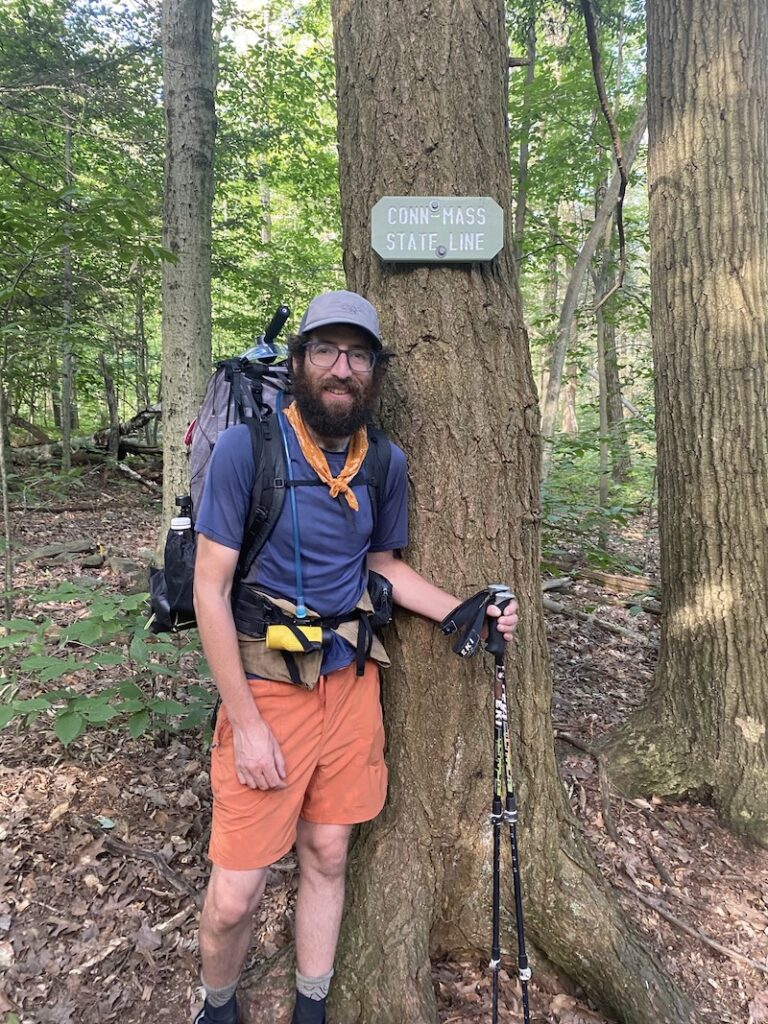
While I had a handful of story ideas already in mind for my own podcast series (called Common Land) when I began my thru-hike, I was hoping that I’d encounter some interesting and unforeseen stories along the way. I definitely had some exciting moments on the trail that translated into stories for my podcast series, but by the time I reached New England I still hadn’t come across any historical stories about the AT that really surprised me.
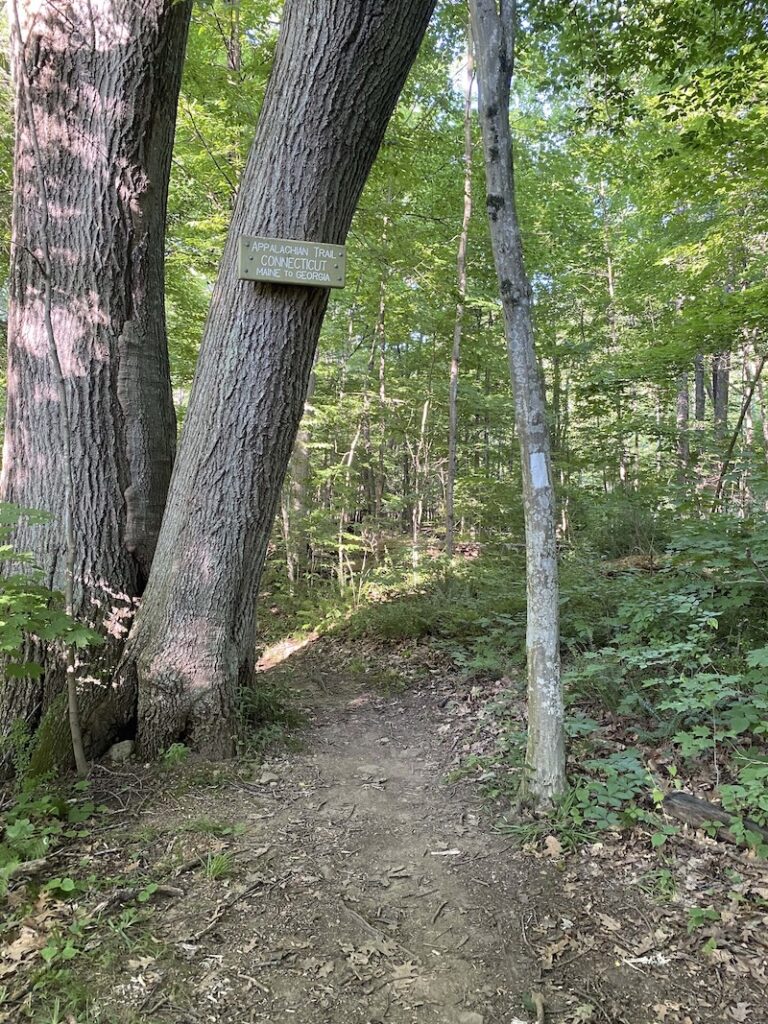
That changed soon after entering Connecticut. I had just crossed the border into Connecticut the following day, and was examining a map on my phone when I came across something unexpected. Like many AT hikers, I was using the app, FarOut, for navigation, and I had downloaded USGS topographic maps within the app. So as I was examining these topo maps and assessing what my next day of hiking would look like, I noticed that I was about to walk through something labeled on the map as the “Schaghticoke Reservation”.
Was this a Native American reservation, I wondered? In all my research on the AT, I had never heard of the trail passing through a reservation before. But because I had decent cell service where I was camping, I was immediately able to learn that the Schaghticoke Reservation was actually one of the first Native American reservations established in North America. In 1736 Connecticut’s general assembly granted this reservation to the Schaghticoke people, and it has been recognized by the state of Connecticut ever since.
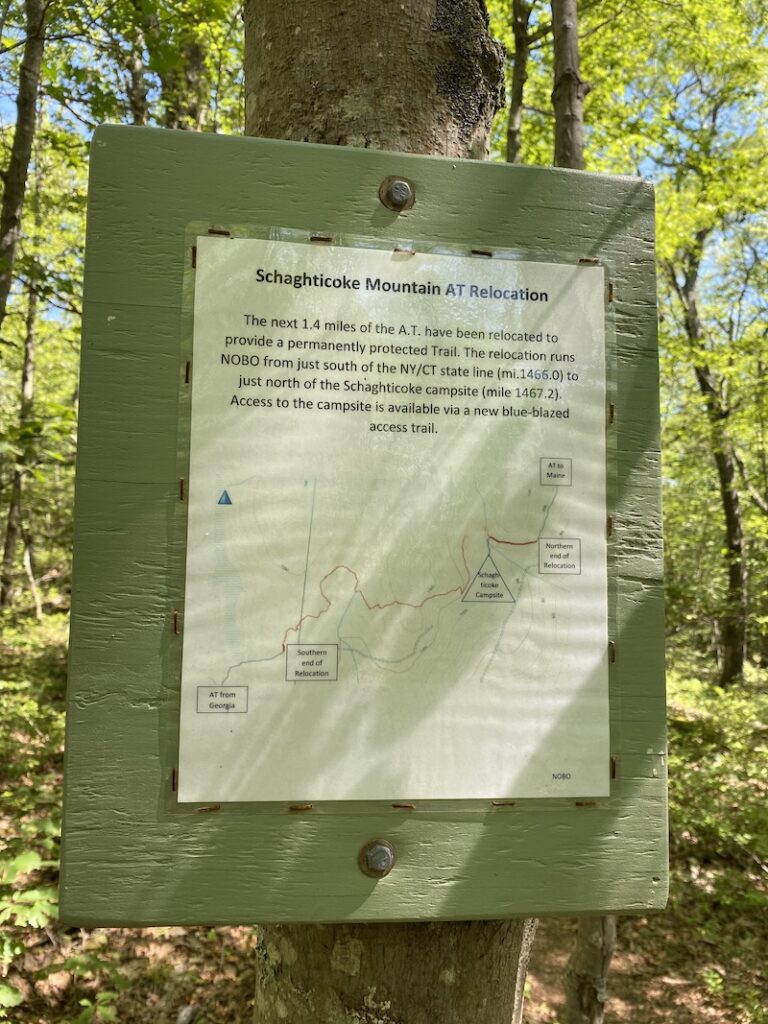
The next day, I approached the Schaghticoke reservation on foot, and found that the path of the AT had been rerouted. The trail no longer wove through the center of the reservation, but instead skirted along its border, never actually entering the reservation. There were signs marking the relocation, but none of these signs explained why the relocation took place. But looking at my map, it was clear that the newly rerouted trail was designed to avoid the reservation.
This was the kind of history that I was eager to dig into in my podcast. I wanted to know more about the Schaghitockes and why the AT had been rerouted around their reservation. The information that I could find online was very limited, but once I finished my thru-hike and began work on my podcast series, Common Land, I started to dig deeper.
The Appalachian Trail, it turns out, was routed through the Schaghticoke Reservation right from the beginning – starting in the 1930s. There may have even been a verbal agreement between the trail builders and Schaghticoke leaders at the time. But if any agreement was made, it came at a time when Schaghticoke rights were severely limited. Tribal members weren’t allowed to reside within their own reservation at the time, and their decision making power was restricted. So any agreement would have been a reflection of the deeply racist power dynamics at play at the time.
Despite the conditions under which the AT was routed through Schaghticoke land, the trail remained on this land without much protest until the late 1970s. But then, in 1978, everything changed. An amendment to the National Trails System Act granted the National Park Service the authority to buy up land adjacent to the AT via eminent domain. This effort to buy up all the land adjacent to the AT is today lauded by the Appalachian Trail Conservancy as a historic effort to protect and preserve the trail. But the Schaghticoke Tribal Nation was unwilling to give up any of their reservation land. The tribe had already lost much of the land originally deeded to them in 1736, and the 43.47 acres alongside the AT that the federal government was seeking amounted to over 10% of their land.
The Schaghticoke Tribal Nation filed a federal lawsuit against the Appalachian Trail Conservancy and the federal government in 1985. Decades of legal battles followed. Part of the problem for the Schaghticoke Tribal Nation was the fact that they didn’t have federal recognition. Although they’ve been recognized by the state of Connecticut since the 1700s, without federal government recognition, the tribe’s legal strategy was severely limited. So they began a parallel legal battle to gain federally recognized status.
All of this came to a head in the year 2000. The Schaghticoke Chief, Richard Velky, was frustrated by the federal government’s slow pace in granting a hearing that would determine the tribe’s status. So Velky threatened to shut down the section of the Appalachian Trail that passed through the Schaghticoke reservation. Velky launched a media campaign, insisting that he would shut down the AT over the busy 4th of July weekend if the federal government didn’t grant a hearing. Two decades of contention and legal fights had led up to this moment.
While the Appalachian Trail Conservancy rushed to pull together a last minute re-route of the trail, Connecticut Attorney General Richard Blumenthal stepped in to ease tensions. After Blumenthal agreed to meet with Velky, the protest was called off, and the AT wasn’t shut down after all. But this incident was a wakeup call for the ATC and the park service.
The Schaghticoke Tribal Nation did gain federal recognition just four years after their Appalachian Trail protest, only to have that status stripped away just a few years later. Velky is still the Schaghticoke Tribal Nation’s Chief, and he continues to fight for federally recognized status.
But tensions have cooled over the past few decades, and in 2021 a coalition of partners, which included the ATC, the park service and the Schaghticoke Tribal Nation, quietly rerouted the AT around the Schaghticoke reservation.
Matt Podolsky is the producer and host of Common Land, a podcast and radio series about the Appalachian Trail produced by the Wild Lens Collective in partnership with New Hampshire Public Radio. Learn more and listen to episodes at: commonlandpodcast.com
Episode eight of Common Land tells the story of the Schaghticoke Tribal Nation and their fight to get the Appalachian Trail off their land. You can listen to this episode in Apple Podcasts, Spotify, or via the embedded player below. Thanks to Chief Richard Velky and Dave Boone (chair of the CT chapter of the AMC) whose voices are included in this episode. Thanks also to Sam Burg, whose Trinity College senior thesis “The Appalachian Trail on (and off) Schaghticoke Land” was an invaluable resource.
