We know a lot about what it’s like to thru hike the Appalachian Trail (and many other long distance trails) for the simple reason that some fraction of thru hikers feel compelled to tell the story of their hike. Why did they embark on an epic journey? What happened to them along the way? And how did they feel when they finished (or failed to finish)? Some thru hikers have written books, others have YouTube channels or Instagram feeds or write blogs. Some have written essays for various magazines and newsletters. We really don’t lack sources for the thru hiking experience.
But, at least on the AT, thru hikers represent less than one-half of one percent of all hikers who step onto the trail each year. That means, of course, that we have a big pile of sources from a tiny fraction of the AT hiking public and comparatively little about the other 99.5% of hikers. But “comparatively little” is not the same thing as “nothing.”
When I set out to write my new book, A Hiker’s History of the Appalachian Trail, I wanted to tell the story of all hikers, not just one segment of the hiking population. Getting access to the experiences of non-thru hikers meant spending a ton of time in the archives of the various trail clubs and organizations that maintain the AT, because it’s there that we can find the stories of everyday hikers. They wrote letters to the trail clubs and the ATC describing their hikes. They sent in clippings from local newspapers. They contributed photographs, slides, and even home movies that showed them and their friends on the trail. And most importantly, they wrote in the register books that the trail clubs place in the more than 250 shelters that dot the trail’s route from Georgia to Maine and back.
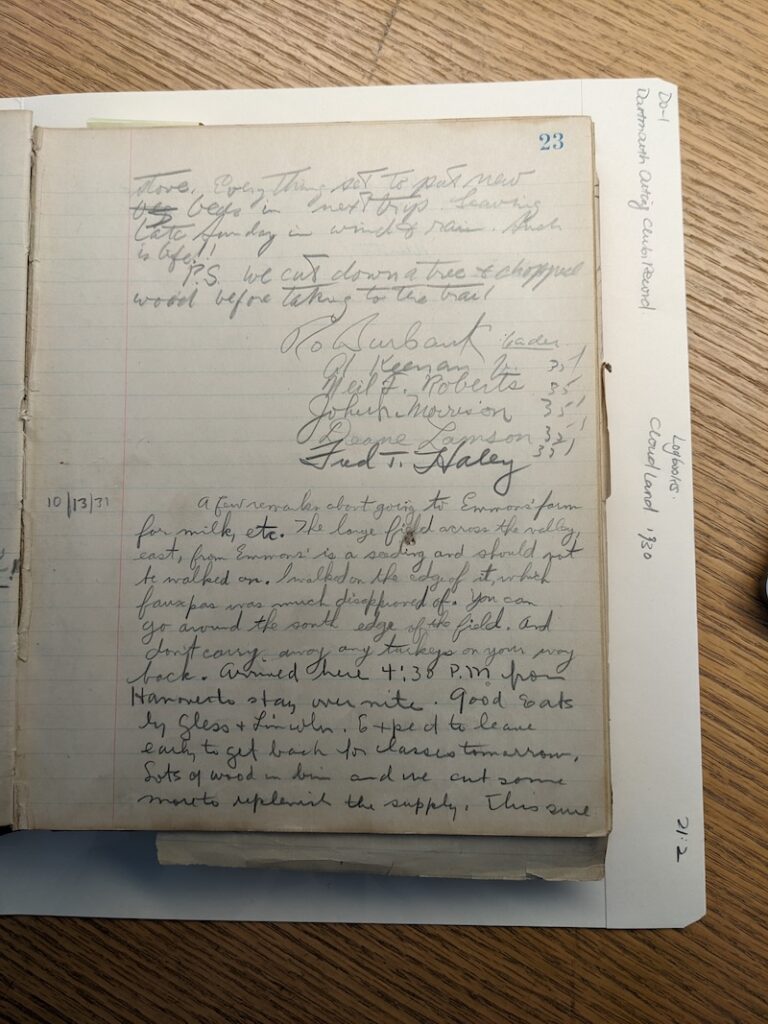
For example, in this register page from the Cloundland Shelter in 1931, a hiker discusses the kinds of food you might obtain from nearby farmers and another group mentions leaving behind firewood for future visitors. These two mundane comments about life on the trail don’t provide us with important insights into the hiker experience. But when you read thousands of these entries — as I did when researching the book — you get a much clearer picture of what it was like to be on the trail in the 1930s, the 1950s, the 1980s, or last week.
I’m happy with the title I (and my publisher) chose for the book, but if I were to choose another title, it would have been, “I saw a bobcat!!!” I can’t tell you how many times hikers wrote about bobcats in one of the registers I read.
Entries like “I saw a bobcat!!!” offer just one of many important insights about the hiking experience — in this case, the excitement hikers feel when they touch the wild, if only for that fleeting moment when a bobcat peers out at them from the edge of the forest.
Touching the wild is just one of the many reasons hikers go to the Appalachian Trail and why they return again and again. And it’s why saving sources like these in the various archives of the trail is so important. Not all the clubs save their registers and others have been lost in fires or other disasters. But enough survive spread across the clubs and across the decades that I was able to stitch together a much bigger story than could ever be told in one exclamation about a bobcat.
